
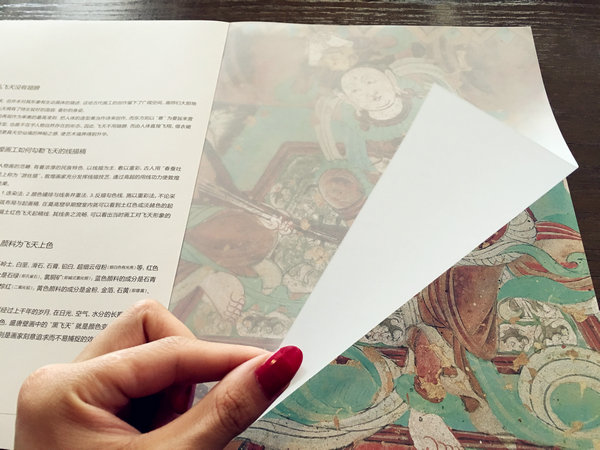
[Photo provided to China Daily]
In the fresco, the flying Apsaras and the gods and goddesses in charge of song and dance play supporting roles.
"This piece from the No 320 Cave from the Tang Dynasty (AD 618-907) is very gorgeous. It is well preserved and has very rich content like various kinds of musical instruments, including flutes and the pipa (a four-stringed Chinese lute). The gestures of the flying Apsaras are very beautiful, too," he says.
In AD 366, a monk named Lezun arrived in Dunhuang and dug the first cave. And in more than 1,000 years of Chinese history, worshippers from different dynasties came to the place, leaving 45,000 square meters of frescoes and more than 2,000 colored sculptures in the 735 caves that have been discovered.
In its long history, the Mogao Grottoes was a place where people could seek comfort and express gratitude, until the Ming Dynasty (1368-1644) when Dunhuang was not part of the empire.
As Buddhism came from India, the early images of the flying Apsaras seem more Indian. But gradually, ancient Chinese painters added more local elements to their work.
 |  |
 Five made-in-China hi-tech breakthroughs
 Beijing Style: Hot pants
 HK-Zhuhai-Macao Bridge to open to traffic
 China opens its first combined transport service to Nepal
 Students take stylish bikini graduations photos
 Charming dancing students pose for graduation photos
 Guizhou, Yunnan section of Shanghai-Kunming railway connected
 Naked models transformed into landscapes, birds and even DRAGONS by body painting artist
 World’s biggest cruise ship Harmony of the Seas to start maiden voyage
 Top 20 hottest women in the world in 2014
 Top 10 hardest languages to learn
 10 Chinese female stars with most beautiful faces
 China’s Top 10 Unique Bridges, Highways and Roads
 Dog lovers ready rescue missions
 How China’s debt collectors go to work
 Albright US rebalance not about limits, containment
 Wealthy Chinese children take class to learn Western table manners
Day|Week
 久久精品视频免费试看


